Is Pilates for beginners over 50 a good idea? Yes, for most people it is. Mat Pilates is a low-impact way to build functional strength, steadier balance and easier daily movement as you get older. The honest picture from the research is encouraging but measured. Pilates for beginners over 50 gives real, useful gains in strength and balance, yet it is not a cure for anything, and it does not build bone density. It rewards steady practice, not intensity.
This guide is written for the complete beginner who is 50 or older and has never done a class. It walks through why the method suits an older body, the benefits that matter most later in life, and what a first gentle session actually involves. It also sets out who should take extra care and when to check with a GP first. The advice draws on current reviews and years of teaching mat Pilates to beginners here in Omagh. If you want the honest version, without the hype, this is it.
| What you want to know | The honest answer |
|---|---|
| Is it safe to start at 50 or 60? | For most people, yes. A gentle beginner class is low impact and adaptable. |
| Will it make me stronger? | Yes, moderately. Reviews show clear gains in functional strength over 8 to 12 weeks. |
| Will it help my balance? | This is its strongest benefit. Balance and steadiness improve reliably. |
| Will it build my bones? | No. Pilates does not raise bone density. Be honest with yourself about that. |
| Do I need to be fit or flexible? | No. You start from where you are, and the movements are scaled to you. |
Why Pilates for Beginners Over 50 Suits the Body
Pilates is slow, controlled and low impact. There is no jumping and no jarring. You work on a mat, at your own pace, and every movement can be made smaller or easier. That is exactly why Pilates for older adults has become so popular. It asks the body to move well rather than move hard. Pilates for beginners over 50 works because it meets you where you are, on any given day.
Our classes are mat-based only. We do not use reformer machines, so there is nothing intimidating to climb onto and no complex kit to learn. A good beginner class for the over-50s focuses on the muscles that keep you steady and upright: the deep core, the hips, the back and the legs. These are the muscles that make getting off the floor, carrying shopping and climbing stairs feel easier.
- Low impact: gentle on the joints, which matters more with every decade.
- Scalable: every move has an easier version, so beginners are never stuck.
- Functional: the focus is on movements you use in real life, not gym numbers.
- Breath and control: the slow pace calms the mind as well as the body.
The Benefits That Matter Most Later in Life
Here is where honesty matters. Some benefits are well supported by research. Others are overstated. Below is what the better reviews actually found for adults over 50, with sources and years, so you know what to expect from gentle Pilates over 50. This is the realistic case for Pilates for beginners over 50, benefit by benefit.
Strength and easier daily movement
A 2021 systematic review of 39 trials in older adults, mostly aged 60 to 75, found a moderate effect on strength (standardised mean difference around 0.63) and on functional tasks like rising from a chair (around 0.51). In plain terms, that means sit-to-stand, stairs and carrying things tend to feel easier after regular practice. The evidence for strength is graded as moderate. For the biggest strength gains, proper resistance training still leads, so treat Pilates as a strong complement rather than the whole answer.
Balance and lower fall risk
This is the standout benefit. A 2018 meta-analysis of 15 trials in adults over 60 found large improvements in static balance and clear gains in dynamic balance. A separate 2021 review found Pilates cut Timed Up-and-Go times by roughly 0.9 seconds, which is a meaningful change for steadiness on your feet. The one honest caveat: studies show Pilates improves the things that lead to falls, such as balance, gait and confidence, but few have measured whether it cuts the actual number of falls. So it is best seen as one part of staying steady, alongside walking and home safety, not a stand-alone falls cure.
Bone health: the honest bit
You will see Pilates sold as a bone-building exercise. The evidence does not support that. A 2021 review and a 2024 trial both found no meaningful effect on bone mineral density in older women. For bones, high-load resistance and impact work have far stronger evidence. There is also a safety point here. If you have osteoporosis or a past spinal fracture (see the NHS guidance on osteoporosis), the safe approach is to avoid repeated end-range forward bending, such as full roll-ups and sit-ups. A good instructor will swap those for neutral-spine and gentle extension work. So Pilates supports strength, posture and balance. It does not build bone, and that is fine when you know it going in.
| Benefit | What the research found for over-50s | Strength of evidence |
|---|---|---|
| Balance | Large gains in static and dynamic balance (15 trials, 2018) | Moderate to strong |
| Functional strength | Easier sit-to-stand and daily tasks over 8 to 12 weeks (2021 review) | Moderate |
| Flexibility and posture | Modest improvements in range and alignment (SMD around 0.41) | Low to moderate |
| Mild back pain | Small to moderate relief, similar to other exercise | Moderate |
| Bone density | No meaningful effect found | Clear: no benefit |
The pattern is reassuring once you read it plainly. The gains are real, they are modest, and they build over a couple of months. That is a good reason to start Pilates for beginners over 50, because the goal is a steady habit that keeps you moving well, not a quick fix.
What to Expect and How It Is Modified
A first gentle class is calmer and quieter than most people imagine. There is no rush and no competition. A good class in Pilates for beginners over 50 is built around comfort and control from the very first minute. Before we begin, we ask a few quick questions about joint replacements, osteoporosis, blood pressure and any back or knee pain. That short chat lets the instructor scale the class to the room. It is the most useful five minutes of the session.
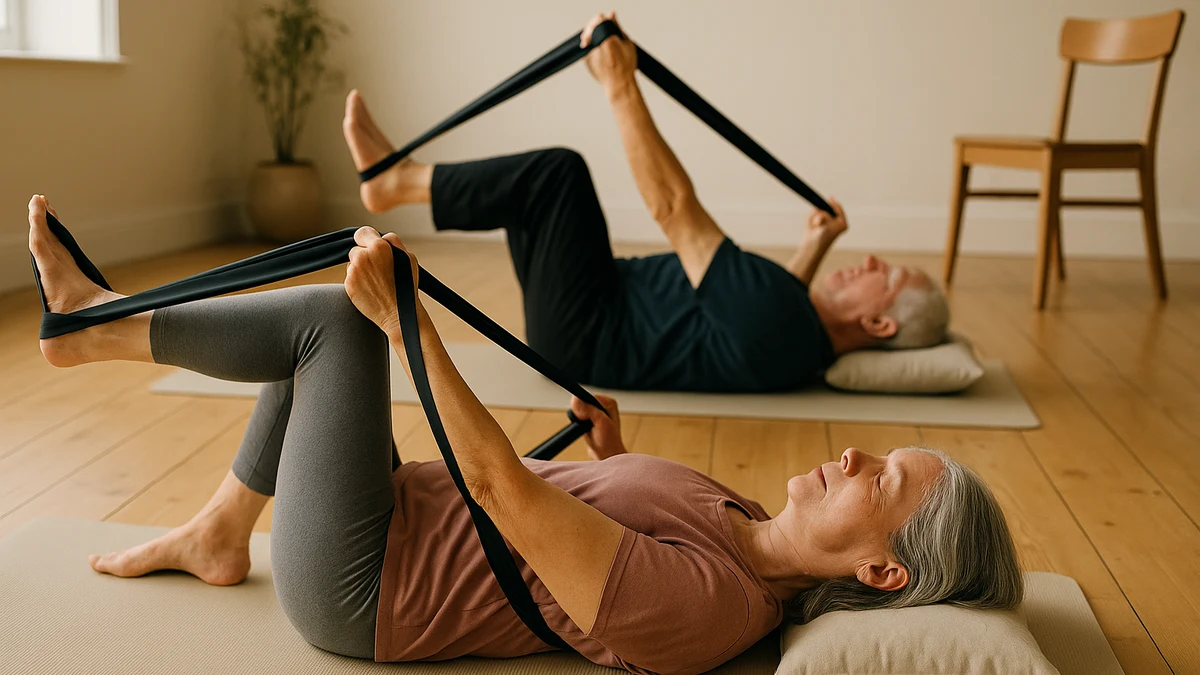
From there, the class is built around slow, precise movement. This is what makes Pilates for seniors and nervous beginners feel doable rather than daunting. Common modifications include:
- Fewer, slower repetitions: quality of movement comes first, never speed.
- Neutral spine: we work with the back’s natural curve rather than flattening or over-bending it.
- Partial curl-ups: full roll-ups are swapped for smaller, safer versions, or skipped where bone health is a concern.
- Props: cushions under the head or knees, a chair for balance, and resistance bands for gentle strengthening.
- A wider base: feet and hands stay grounded for support, with harder single-leg work saved for later.
- Shorter sessions to begin: 30 to 40 minutes is plenty when you are new or coming back after a long break.
Most research programmes ran two to three sessions a week for 8 to 12 weeks. Within that window, people usually notice easier movement, steadier balance and a little more confidence. Come as you are. You do not need special clothing, and every mat, block and band you need is provided.
Staying Safe, and When to Check With Your GP
Pilates is gentle, but a sensible check first is always worth it. The NHS guide to Pilates recommends telling your instructor about any health condition and getting advice if you are unsure. Some groups should speak to a GP or physiotherapist before starting, or before moving past the gentlest beginner level.
Please check with your GP, physiotherapist or, if it applies, your midwife before you start, especially if you have osteoporosis, a recent joint replacement, uncontrolled blood pressure, or unexplained back pain. Always tell the instructor about any condition, injury or pregnancy so the class can be adapted for you. Stop and speak up if you feel pain, dizziness or unusual breathlessness.
- Osteoporosis or a past spinal fracture: get advice first, and choose a class that avoids repeated forward bending and end-range flexion.
- Recent hip or knee replacement: you usually need clearance and specific movement limits for the first few months, so ask your surgeon or physiotherapist.
- Uncontrolled high blood pressure or a heart condition: get assessed first, as some positions and breath-holding can raise pressure briefly.
- Pregnancy: this is uncommon over 50 but not impossible. It needs a pregnancy-trained instructor and prior medical advice.
- New, severe or unexplained back pain: or any pain with night symptoms or numbness should be checked by a health professional before you exercise.
None of this is meant to worry you. Most people trying Pilates for beginners over 50 start with no restrictions at all. The point is simple: a quick word with the right person means your class can be shaped safely around you from day one.
How to Start Gently
You do not need to be fit, flexible or experienced. To give yourself the best start with Pilates for beginners over 50, keep it simple and steady:
- Pick a genuine beginner class, not a mixed-level one, so the pace matches you.
- Aim for one to two sessions a week, and give it at least 8 to 12 weeks before you judge the results.
- Tell the instructor about any condition or injury before your first class.
- Focus on control and breathing, not on how far you can reach. The small, precise movements are the point.
- Be patient. The research is clear that steady, regular practice is what keeps the benefits.
A class gives you two things a home video cannot: an instructor watching your alignment, and a set time that builds the habit. When you are ready, our mat Pilates classes at Orba teach the foundations gently, in small groups, so anyone new to Pilates for beginners over 50 feels looked after from the first session. You can check the current class timetable, read about the studio and our instructor, or browse our gentle yoga classes if you would like to pair the two. Starting is the only hard part.
Pilates for Beginners Over 50: Frequently Asked Questions
Is 50, 60 or 70 too old to start Pilates?
No. Mat Pilates is one of the most age-friendly forms of exercise, because every movement can be scaled to you. Most research on Pilates for older adults involves people aged 60 to 75, and it shows clear gains in strength and balance. Age is rarely the barrier. Finding a suitable class in Pilates for beginners over 50 is what matters.
How long before I notice a difference?
Most studies run two to three sessions a week for 8 to 12 weeks. Within that time, people usually report easier daily movement, steadier balance and a little more confidence. Strength and flexibility changes are often measurable by around 8 weeks, with larger effects by 12 weeks and beyond.
Is Pilates safe if I have osteoporosis?
It can be, with the right modifications, but check with your GP or physiotherapist first. The key is to avoid repeated end-range forward bending, such as full roll-ups and sit-ups, and to work with a neutral spine instead. An instructor experienced with bone health should adapt the class for you.
Will Pilates help my balance and stop me falling?
Balance is Pilates’ best-supported benefit for older adults, with reviews showing reliable improvements. It clearly improves the factors behind falls, like steadiness, gait and confidence. Evidence that it cuts the actual number of falls is still limited, so treat it as one helpful part of staying steady, alongside walking and home safety.
Do I need any equipment or experience?
No experience is needed, and no reformer machines are used in our classes. We provide the mat, blocks, cushions and resistance bands. Just wear comfortable clothes you can move in. A genuine beginner class will teach the breathing and foundations before anything else.
Related reading
- Pilates Before and After: What Results to Realistically Expect
- Pilates for Back Pain: A Gentle, Practical Guide
- Pilates for Beginners: What to Expect in Your First Mat Class
- The Benefits of Pilates: An Honest, Evidence-Based Guide
Try Gentle Mat Pilates at Orba in Omagh
Our mat-based “Pilates for All” classes suit Pilates for beginners over 50 perfectly, helping you build strength and balance at a calm, unhurried pace. You get expert instruction in small groups at Orba Yoga Retreat & Health Spa in Omagh, Co. Tyrone, with every mat, block and band provided. There are no reformer machines and no experience needed.
Mat “Pilates for All” from £54 · Small groups · Omagh, Co. Tyrone
Call 07596 592117 or email namaste@orbayogaspa.com to book your first class.