What is chair yoga? Chair yoga is a gentle form of yoga practised sitting on a sturdy chair, or standing and using the chair for support, so you get the movement and breathing of a normal class without kneeling on the floor. It suits older adults, anyone with limited mobility, and desk workers who sit for long hours. You do not need to be flexible, and you can start right away with nothing more than a steady chair.
This guide walks you through a short seated sequence, the reasons it helps, and how to keep it going through a busy week. It is written from years of teaching gentle classes here in Omagh, so the focus is on what real people manage on an ordinary day, not on advanced shapes. If you have wanted to try yoga but worried about getting up and down from a mat, this is a kinder starting point that still gives you the calm, steady feeling a good class leaves behind.
Chair Yoga at a Glance: A Simple Seated Sequence
Here is a full seated round in one place. Sit tall towards the front of the chair, feet flat and hip width apart, and let each move last a few slow breaths. The numbers below are a guide, not a rule, so slow down where a pose feels good and skip anything that does not suit your body today.
| Seated move | Reps or hold | What it helps |
|---|---|---|
| 1. Seated cat and cow | 6 slow rounds | Mobilises the spine and eases stiffness |
| 2. Neck release, side to side | 3 breaths each side | Loosens the neck and shoulders |
| 3. Seated side bend | 3 breaths each side | Opens the ribs and the waist |
| 4. Seated twist | 4 breaths each side | Gently wrings out the mid back |
| 5. Ankle and wrist circles | 8 each way | Wakes stiff joints and helps circulation |
| 6. Seated leg lift | 6 each leg | Strengthens the thighs and knees |
| 7. Seated forward fold | 5 slow breaths | Releases the lower back and calms the head |
Add it up and the round takes about ten minutes. That is the point of chair yoga. A short seated routine you finish beats a long floor class you keep putting off.
Why Chair Yoga Works So Well
Chair yoga works because it meets your body where it is. A stable seat removes the hardest part of a normal class, the getting down to the floor and back up, so you can put your attention on the movement and the breath instead. That makes it a realistic daily habit for people who would never manage a mat class, and it still delivers the parts that matter most.
None of this is a cure, and it helps to be honest about the size of the effect. Gentle seated movement and slow breathing support mobility, circulation and general wellbeing rather than treating a medical condition. The benefits are real, though, and beginners tend to notice them quickly:
- Easier movement: the spine, hips and shoulders loosen, so everyday tasks like reaching and turning feel less stiff.
- Better circulation: ankle circles and leg lifts nudge the blood moving in the legs after long spells of sitting.
- A calmer head: slow breathing gently shifts the nervous system towards rest, which takes the edge off a tense day.
- Steadier balance: the seated strength work supports the muscles you rely on to stand, walk and stay confident on your feet.
The health service backs the wider habit. The NHS sitting exercises guide shows a set of seated movements very like these and notes that gentle activity from a chair is a genuine way to stay active, especially for older adults and anyone less steady on their feet.
Chair Yoga Poses to Try, Step by Step
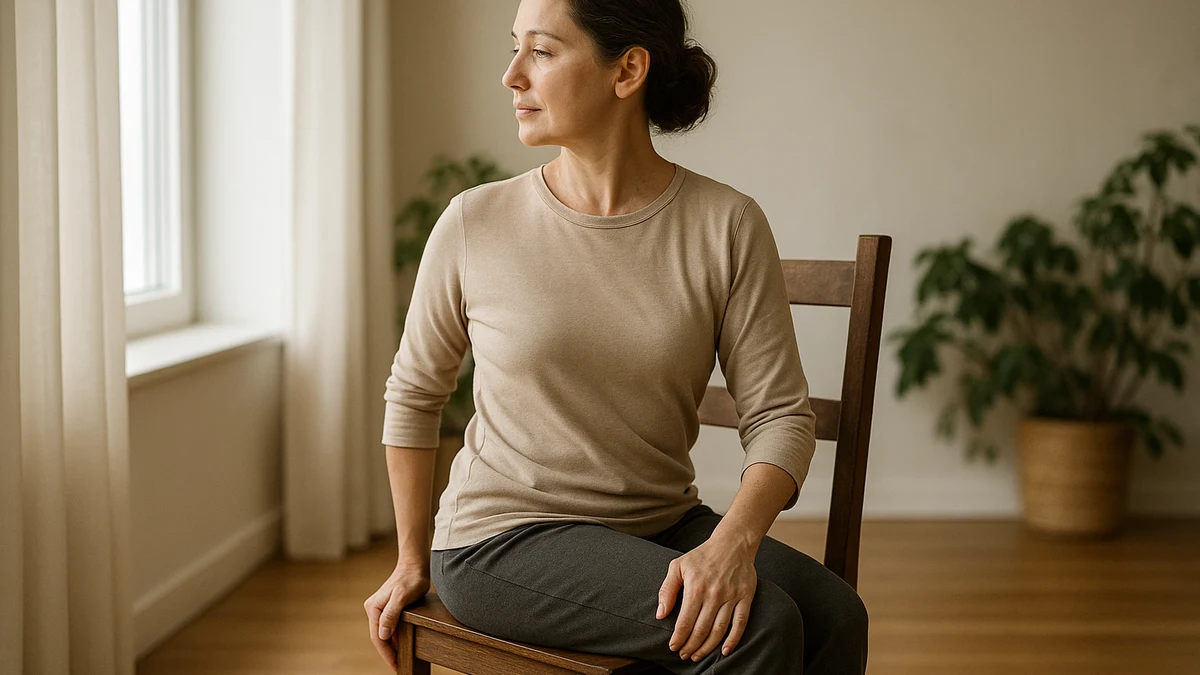
These chair yoga poses follow the order in the table above. Use a firm, stable chair with no wheels, sit away from the backrest so your spine can move, and keep both feet flat on the floor. Breathe through your nose and let the breath set the pace.
- Seated cat and cow. Rest your hands on your thighs. Breathe in and lift your chest, rolling the shoulders back. Breathe out and round the spine, tucking the chin. Move slowly with the breath.
- Neck release. Sit tall and let your right ear drop gently towards your right shoulder. Hold for three breaths, come back to centre, then change sides. Keep the shoulders soft.
- Seated side bend. Reach your left arm up and lean gently to the right, feeling a long stretch down the left side. Hold, then swap. Keep both sitting bones on the seat.
- Seated twist. Place your right hand on the outside of your left thigh and turn gently to the left, growing tall as you go. Hold for four breaths, then change sides.
- Ankle and wrist circles. Lift one foot slightly and circle the ankle eight times each way, then the other. Do the same with the wrists. Small joints wake up fast.
- Seated leg lift. Hold the sides of the chair, straighten one leg to about knee height, hold a breath, then lower. Repeat six times each leg to build gentle strength.
- Seated forward fold. With feet wide, fold slowly forward from the hips and let your head and arms hang towards the floor. Rest here for five breaths, then roll up one bone at a time.
Chair yoga for beginners: start gently
If you are new, chair yoga for beginners is mostly about restraint. Move only as far as feels easy, keep the range small in the early weeks, and let it grow on its own. There is no reward for forcing a stretch, and a pose that pinches or hurts is a pose to back out of. Comfort in these first sessions is what keeps you coming back, and coming back is the whole game.
Let the breath lead. If a movement leaves you holding your breath or gritting your teeth, you have gone too far, so ease off until the breath flows again. Choose a chair that does not tip or slide, and if you feel at all wobbly, keep one hand on the seat throughout. That single habit will protect you more than any clever alignment tip.
Chair Yoga for Seniors and Limited Mobility
Chair yoga for seniors is one of the most popular reasons people try it, and for good reason. It keeps the body moving without the strain of getting down to the floor, it supports the balance and leg strength that matter for staying independent, and it can be done in a warm room at a pace that suits the day. The same gentle approach helps anyone with limited mobility, a desk-bound job, or a body that is easing back into movement.
Use the table below to see who chair yoga tends to suit and a sensible place to begin. There is no wrong answer, and you can move between these as your week and your energy change.
| Who it suits | Why chair yoga helps | A place to start |
|---|---|---|
| Older adults | Supports balance and mobility without floor work | 10 minutes, 3 times a week |
| Desk workers | Counters long hours of sitting and screen time | 5 minutes at lunch, most days |
| Limited mobility | No getting up and down from the floor | Seated poses only, one round |
| Easing back after injury | Low load, slow and easy to control | Check with your GP first, then start small |
A quick word on health. Chair yoga is gentle, but it is still movement, so use common sense. If you have a heart condition, recent surgery, a joint problem, or you are pregnant, have a word with your GP or physiotherapist before you begin, and tell whoever teaches your class so they can adapt the poses for you.
Common Mistakes to Avoid
A few small errors trip up most beginners. Fix these early and the practice feels good rather than a chore.
- Slouching into the backrest. Sit forward so the spine can move freely. A soft cushion behind the lower back is fine if you need it.
- Using the wrong chair. Skip anything on wheels, and skip soft armchairs. A firm dining chair with a flat seat is ideal.
- Holding your breath. If the breath stops, ease off. Steady breathing is the whole point of a gentle practice.
- Pushing into pain. A stretch should feel like a stretch, never a sharp pinch. Back off the moment it bites.
- Rushing the poses. Slow is the whole benefit. Let each move last a few breaths rather than racing to the end.
For a plain, well-sourced overview of why gentle activity matters at every age, the NHS on the health benefits of exercise is a reliable place to read more.
Bringing Chair Yoga Into Your Week
The sequence is easy. The habit is the harder part, and a few simple choices make it far more likely to last past the first week.
- Attach it to something you already do. Practise with your morning cup of tea or right after lunch, so it rides on an existing habit.
- Keep the chair ready. Leave a suitable chair in a clear spot so there is nothing to set up and no reason to skip.
- Aim low on tired days. On a rough day, do two or three poses. Keeping the rhythm matters more than the length.
- Add a guided class each week. A teacher can adjust each pose to your body and answer the questions a video never will.
A home practice and a class work best together. At home you keep the daily rhythm, and in a class someone watches how you move, adapts the poses, and keeps you safe. If you would like that guidance, our yoga classes in Omagh welcome all levels gently, in small groups, so seated and supported work is easy to ask for. You can check the current class timetable, read more about the studio and setting, or book a class when you are ready to begin.
Chair Yoga: Frequently Asked Questions
Is chair yoga good for beginners?
Yes. Chair yoga for beginners is one of the gentlest ways to start, because a sturdy seat removes the hardest part of a normal class. Move slowly, keep the range small, and skip anything that hurts. No flexibility or experience is needed, and ten minutes of seated poses a few times a week is enough to feel a real difference.
Does chair yoga really count as exercise?
It does. Seated movement, gentle strength work and slow breathing all support mobility, circulation and wellbeing, and the NHS lists sitting exercises as a genuine way to stay active. Chair yoga will not replace brisk walking for fitness, but for stiffness, balance and a calmer head it earns its place in the week.
What kind of chair should I use?
Use a firm, stable chair with a flat seat and no wheels, such as a dining chair. Avoid soft armchairs and anything that tips or slides. Sit towards the front so your spine can move, keep both feet flat on the floor, and place the chair on a non-slip surface for extra safety.
Is chair yoga suitable for seniors with health conditions?
Chair yoga for seniors is gentle and adaptable, which is why it suits many older adults. It is not a treatment, though. If you have a heart condition, recent surgery, a joint problem, or you are pregnant, check with your GP or physiotherapist first, and tell your instructor so the poses can be adjusted for you.
How often should I do chair yoga?
Little and often works best. Three short sessions a week is a good start, and many people build up to a few minutes most days once the habit is set. Consistency matters more than length, so start with ten minutes, keep it regular, and add time only when it feels easy.
Related reading
- Yoga for Sleep: A Gentle Wind-Down Routine
- Yoga for Back Pain: Gentle Poses and What Actually Helps
- Yoga for Stress: Simple Ways to Calm Your Mind
- Yoga for Beginners: What to Expect in Your First Class
Try a Gentle Class at Orba in Omagh
A home routine is a great start, and a guided class makes it safer and easier to stick with. At Orba Yoga Retreat & Health Spa in Omagh, Co. Tyrone, all-levels classes run in a calm studio with expert instruction from Brídín, who has taught here since 2012. Small class sizes mean seated and supported options are easy to ask for, and every pose can be adapted to you.
All levels welcome · Mon to Sat · Omagh, Co. Tyrone
Call 07596 592117 or email namaste@orbayogaspa.com to ask about gentle and seated options.
About the author
Brídín is the owner and head yoga and Pilates instructor at Orba Yoga Retreat & Health Spa in Omagh, Co. Tyrone. A qualified instructor, she has taught yoga to beginners and regulars here since 2012, in a calm studio set in roughly nine acres of countryside at the foot of the Sperrin Mountains. She teaches all levels, with gentle and seated options available and equipment provided.
Ready to begin? Book a class or ask a question by calling 07596 592117 or emailing namaste@orbayogaspa.com.